
SBA Acquisition Loan Credit Score Requirements: What Lenders Look For, What Score You Actually Need, and How to Build It Before You Apply

Fast, Simple SBA Guidance Nationwide
Our SBA Loan Specialists are ready to answer your questions. Call (844) 821-1800 M–F, 6am–5pm.
What SBA Acquisition Loan Lenders Evaluate in Your Credit Profile
Why Your Personal Credit Score Carries the Weight
SBA acquisition loans require a personal guarantee from every owner with 20% or more stake in the acquiring entity. That guarantee means you’re promising to repay the loan with your personal assets if the business can’t cover it. Because your personal assets are on the line, the lender evaluates your personal credit, not just the business you’re buying.
This is the single most important thing to understand about SBA acquisition loan credit score requirements. The lender isn’t checking your credit out of curiosity. Your personal guarantee makes your credit history a direct measure of the lender’s risk. A strong personal credit profile tells the lender you’ve honored financial commitments before and you’ll likely honor this one.
If you have a business partner or co-borrower on the acquisition, their personal credit gets pulled too. Every individual with 20% or more ownership provides a personal guarantee and undergoes a full credit evaluation.
Credit Score Components Beyond the FICO Number
SBA acquisition loan lenders pull your personal FICO score, but they don’t stop there. Most lenders also check the FICO Small Business Scoring Service score, called the SBSS. The SBSS combines your personal credit data with business credit data and financial information into a single number between 0 and 300.
The SBSS applies specifically to SBA loans of $350,000 or less. For loans at or below that amount, the SBA uses the SBSS as an electronic prescreen. You generally need an SBSS score of 165 or higher to pass that prescreen. Scores below 165 don’t automatically result in a decline, but the loan skips streamlined processing and goes to a full manual underwrite, which takes longer and invites more scrutiny.
For SBA acquisition loans above $350,000, the SBSS prescreen may not apply. The lender goes straight to full underwriting and evaluates your FICO score, credit report, and financial statements directly. If your acquisition loan is in the $500,000 to $5 million range, your FICO score and the business’s cash flow carry more weight than the SBSS.
Beyond the scores themselves, lenders review your full credit report for patterns. They look at how you’ve managed debt over time, not just where you stand today. A 700 FICO with a recent collection tells a different story than a 700 FICO with 15 years of clean payment history. That pattern recognition is what separates a surface-level credit check from SBA-level underwriting.
How Lenders Weigh Credit Utilization
Credit utilization is the percentage of your available revolving credit that you’re currently using. If you have $50,000 in total credit card limits and you’re carrying $20,000 in balances, your utilization is 40%.
SBA acquisition loan lenders treat utilization as a signal of cash management. High utilization suggests you’re relying on credit cards to cover operating expenses, which raises questions about whether you can handle a loan payment on top of existing debt. Since an SBA acquisition loan adds a significant monthly obligation, lenders want proof that you aren’t already stretched.
Most lenders prefer utilization below 30%. Below 10% is ideal. Utilization above 50% is a yellow flag that triggers additional questions about your cash reserves and monthly obligations.
The number updates every billing cycle. Your utilization on the day the lender pulls your credit is the one they see. A balance you paid off two days after the statement closed still shows as owed until the next cycle reports. This timing detail matters because your pull date is outside your control once you submit your application.
TIP: We suggest checking your utilization ratio on each individual card, not just your overall ratio. A $500 balance on a card with a $1,000 limit is 50% utilization on that card, even if your total utilization across all cards is 15%. FICO scores factor per-card utilization separately. In our experience, borrowers who flatten their balances across cards instead of maxing one gain 10-20 extra points.
The Role of Credit History Length
Lenders want to see at least 7 years of active credit history. Longer history gives them more data points to evaluate how you handle debt across different economic conditions.
Average age of accounts matters too. If you opened five credit cards in the last year to build credit, your average account age drops, even if your oldest account is 15 years old. Lenders notice that pattern because it looks like someone scrambling to build a profile rather than someone with an established track record.
Thin files (profiles with fewer than 3 active trade lines) create a different problem. The lender simply doesn’t have enough information to assess risk. A 720 score on a thin file carries less weight than a 690 on a profile with 10 active accounts and a decade of payment data. For SBA acquisition loans specifically, lenders want to see that you’ve managed multiple types of credit over time, not just a single credit card.
How Derogatory Marks Affect Your Application
Late payments, collections, charge-offs, and bankruptcies all appear on your credit report, and SBA lenders review each one. These marks carry more weight in acquisition loan underwriting than they do for a standard credit card application because the loan amounts are larger and the repayment terms are longer.
A single 30-day late payment from 4 years ago is usually manageable if the rest of your history is clean. Two or more recent late payments within the last 12 months raise serious concerns about your ability to manage recurring obligations.
Collections and charge-offs need to be either paid or in an active payment plan before most SBA lenders will proceed. An unpaid $800 medical collection can hold up a $500,000 acquisition loan. The dollar amount doesn’t matter as much as the signal it sends: this person has unresolved debts.
Bankruptcy has specific seasoning requirements. Most SBA lenders require at least 3 years since a Chapter 7 discharge and at least 1 year since a Chapter 13 dismissal or discharge. Some preferred lenders require longer. These timelines mean that if you’ve had a bankruptcy, the clock on your SBA acquisition loan eligibility started the day of your discharge.
Credit Inquiries and the 45-Day Shopping Window
Hard inquiries appear on your credit report when a lender pulls your credit. Each one can drop your score by 2 to 5 points.
The credit bureaus recognize that shopping for a single loan generates multiple pulls. FICO treats all mortgage and loan inquiries within a 45-day window as a single inquiry for scoring purposes. So if you apply to three SBA lenders within 45 days, the impact on your score is the same as one application.
The key is timing. Space your applications within that 45-day window. If you apply to one lender in January and another in April, those count as two separate inquiries. This 45-day rule is especially relevant for SBA acquisition loans because the process often involves conversations with multiple preferred lenders before choosing one.
SBA lenders typically don’t penalize you for rate-shopping inquiries. They understand the process. But 15 hard inquiries across credit cards, auto loans, and business financing in the last 6 months tells a story of someone stretching for credit, and that concerns underwriters.
Red Flags That Cause an Immediate Decline
Some credit report items stop an SBA acquisition loan before underwriting even starts. Knowing these red flags before you apply saves you from a decline that stays on your record and costs you time.
Active tax liens from the IRS or state tax authorities are disqualifying. The SBA requires that all tax obligations be current before guaranteeing a loan. An installment agreement with the IRS is acceptable if you’ve made at least 3 consecutive on-time payments, but an unaddressed tax lien is a hard stop.
Bankruptcy discharged within the last 3 years for Chapter 7, or an active Chapter 13 without court approval to take on new debt, will result in a decline.
Outstanding judgments and unresolved legal actions against you create similar problems. If a court has entered a judgment and you haven’t satisfied it or arranged a payment plan, most lenders won’t proceed.
Foreclosure within the last 3 years is a significant barrier. Even after the seasoning period, lenders look carefully at the circumstances. Every one of these red flags has a resolution path, but each one requires time. That’s why checking your credit report early is the most important step you can take before pursuing an SBA acquisition loan.
TIP: We recommend pulling your free reports from annualcreditreport.com right now and searching for these specific items: any account you don’t recognize, any balance marked “in collections,” any tax lien listed as “active,” and any bankruptcy you’ve already discharged that still shows as open. If you find any of those four, resolve them before starting an SBA acquisition loan application. One unresolved item can stall a 60-day process for months.
The Credit Score You Actually Need for an SBA Acquisition Loan
Now that you know what lenders evaluate across your full credit profile, the next question is what score actually gets you approved. The answer depends on the SBA program, the loan size, and what else you bring to the table.
Score Tiers: What Each Range Gets You
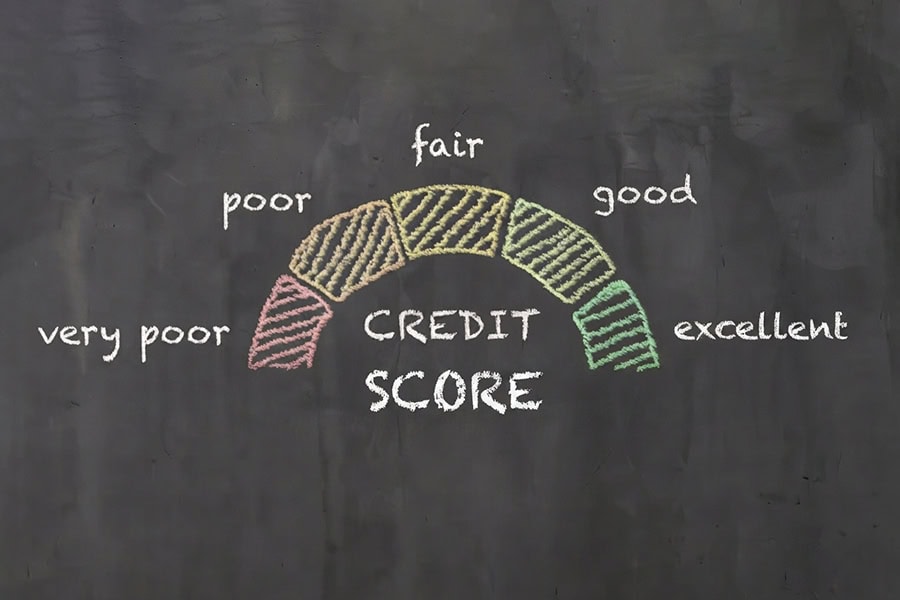
The SBA doesn’t publish an official minimum credit score. Each SBA-approved lender sets its own floor. But the industry has settled into predictable tiers, and knowing which tier you fall into tells you what to expect.
| Score Range | Tier | What to Expect |
|---|---|---|
| Under 640 | Very difficult | Approval is unlikely through most preferred lenders. You’ll need substantial collateral, a large down payment (20-25%+), and a DSCR well above 1.25 to have any chance. Most borrowers at this level should focus on building their score before applying. |
| 640-649 | Possible with strengths | A few lenders will consider this range, but only with strong compensating factors: high DSCR, significant industry experience, and additional collateral. Expect higher rates and longer processing. |
| 650-679 | Baseline | You meet the minimum for many SBA lenders. Expect stricter scrutiny on cash flow, higher equity injection requirements (15-20% instead of 10%), and conditional approval with documentation requests. |
| 680 and above | Competitive | This is where approvals get smoother and loan terms improve. You’ll qualify with most preferred lenders and have room to negotiate rates closer to the lower end of the SBA’s allowed spread. |
For SBA 7(a) acquisition loans, which are the most common program for buying a business, the 680 floor is where most preferred lenders feel comfortable. For SBA 504 loans, which are more commonly used for real estate and equipment, lenders generally expect a similar threshold. The 504 program involves a Certified Development Company as a second lender, and both the CDC and the first-position lender review your credit independently.
The Competitive Range That Unlocks Better Terms
Getting approved and getting good terms are two different outcomes. A 680 gets you through the door. A 720 or higher gets you through the door with leverage.
Borrowers above 720 typically see the most favorable rates. For SBA 7(a) loans, that’s currently Prime + 1.5% to Prime + 2.75%, depending on loan size and term. Borrowers in the 680-700 range more often land at the higher end of the SBA’s allowed spread.
On a $500,000 SBA acquisition loan with a 10-year term, the difference between Prime + 1.75% and Prime + 2.75% is roughly $35,000 to $45,000 in total interest paid. Your credit score is directly connected to a real dollar amount. Understanding this connection is what makes the difference between treating your credit score as a checkbox and treating it as a financial tool.
Lenders also use your score to calibrate how much documentation they request. A 740 application with clean history might get approved with standard documentation. A 685 application often triggers requests for additional bank statements, a letter of explanation for derogatory items, and more detailed cash flow projections.
How Loan Size and Deal Structure Shift the Requirement
Larger loan amounts invite more scrutiny. A $150,000 SBA acquisition loan at 690 might sail through. A $2 million acquisition loan at the same score faces a longer review and more conditional requirements.
The SBA’s maximum 7(a) loan amount is $5 million. As the loan amount approaches that cap, lenders tighten their credit expectations. You’ll rarely see a $4 million SBA acquisition loan approved for a borrower under 700.
Deal structure matters too. A buyer putting 20% down (versus the SBA minimum of 10%) signals skin in the game. That extra equity can offset a score that’s 10-15 points below the lender’s preferred range. Seller financing for a portion of the purchase price works similarly because it reduces the SBA lender’s exposure. If you’re on the edge of the credit score requirement, structuring the deal to reduce the lender’s risk is one of the most effective levers you have.
Compensating Factors That Offset a Borderline Score
A credit score between 640 and 679 doesn’t automatically mean a decline. Lenders weigh compensating factors that can bring a borderline application into the approval range. These factors give the lender reasons to say yes when the score alone might not.
DSCR (Debt Service Coverage Ratio): This is the single most powerful compensating factor. DSCR measures whether the business generates enough cash to cover the loan payment. A DSCR of 1.25 means the business produces $1.25 in cash flow for every $1.00 of debt service. Most SBA lenders require at least 1.25. A DSCR of 1.5 or higher can offset a score in the 650-679 range. It proves the business can carry the debt on its own.
Down payment above minimum: The SBA requires a minimum 10% equity injection. Putting 15% to 25% down reduces lender risk and signals commitment. For borrowers under 680, a larger down payment is often the difference between approval and decline.
Industry experience: If you’ve spent 10 years in the industry you’re buying into, lenders view you as a lower operational risk even if your credit isn’t pristine. The SBA specifically asks about management experience in the acquisition. Having direct experience in the same industry as the business you’re purchasing is one of the strongest non-financial compensating factors.
Collateral coverage: Real estate or equipment that secures the loan beyond the business assets adds a safety net for the lender.
Liquid reserves: Cash reserves equal to 3 to 6 months of the projected loan payment demonstrate that a slow month won’t trigger a default.
TIP: At Small Business Funding, we’ve walked hundreds of business owners through the DSCR calculation before their first lender conversation. We suggest dividing the target business’s annual net operating income by the total annual debt payments (including your projected SBA loan payment). If the result is below 1.25, the business’s cash flow probably can’t support the loan at the size you’re requesting, even if your credit score is 750. This one number tells you more about your approval odds than any credit score.
How Your Score Affects Interest Rates and Total Cost
SBA 7(a) loans have capped interest rates set by the SBA. Lenders can charge up to Prime + 2.75% for loans of $50,000 or more with terms over 7 years. Within that cap, your credit score determines where you land.
The cost difference extends beyond the interest rate. The SBA guarantee fee ranges from 0% on loans up to $150,000 to 3.75% of the guaranteed portion on loans over $1 million. Your credit score doesn’t directly change the guarantee fee schedule, but a lower score may push you toward a lender that charges the maximum spread, compounding the cost.
Packaging fees, which some lenders charge for assembling and processing the SBA application, are more common on borderline applications. A clean 740 application rarely sees a packaging fee. A 670 application often does. These fees typically range from $2,000 to $5,000, which adds to the total cost of the loan before you’ve even received the funds.
How to Build Your Credit Score Before You Apply
You now know the score you need and the factors that can help if you’re close. The next step is building your credit to that level before you apply. Every point you gain before submitting your application improves your terms, reduces your costs, and speeds up the process.
The Timeline: How Far in Advance to Start
Start working on your credit at least 6 months before you plan to apply. Twelve months is better if your score needs significant improvement.
Credit score changes don’t happen overnight. Paying down a credit card balance today won’t show up on your credit report until the next statement closes and the issuer reports to the bureaus, which can take 30 to 45 days. If you need to dispute errors, each dispute round takes 30 to 45 days for the bureau to investigate. Two rounds of disputes plus balance reductions can easily consume 4 months.
If you’re below 650 and need to reach 680, plan for 9 to 12 months. The jump from 620 to 650 is usually faster than the jump from 670 to 700 because the early gains come from fixing obvious problems like high utilization and unresolved collections.
High-Impact Actions That Move Your Score Fastest
Not all credit-building actions produce equal results. Focus on the two or three moves with the highest point-per-month return.
Pay down revolving balances below 30% utilization. This is the single fastest way to raise your score. Utilization changes reflect on your next statement cycle, within 30 to 45 days. Going from 60% utilization to 25% can produce a 30 to 50 point increase in one cycle. Since SBA lenders treat utilization as a cash management signal, this action addresses both your score and the lender’s confidence in your financial habits.
Become an authorized user on a family member’s old, low-utilization card. If a family member has a credit card with 10+ years of history and low utilization, being added as an authorized user imports that account’s history and limit to your profile. This can increase your average account age and lower your overall utilization in a single reporting cycle.
Request credit limit increases without a hard inquiry. Many issuers will increase your credit limit through a soft-pull review if you call and ask. A higher limit on the same balance immediately reduces your utilization ratio. This takes one phone call and updates within 1-2 statement cycles.
Set up autopay on every account. Payment history accounts for approximately 35% of your FICO score. A single missed payment can drop your score 60 to 100 points. Autopay eliminates this risk entirely for the cost of 5 minutes of setup per account. Keeping all personal and business bills current is the most basic requirement, and autopay makes it automatic.
TIP: We suggest calling each credit card issuer and saying this exact sentence: “I’d like to request a credit limit increase. Can you do a soft pull instead of a hard inquiry?” Most major issuers, including Chase, Capital One, and American Express, offer soft-pull increases. If the issuer insists on a hard pull, decline and try again in 6 months. A $5,000 limit increase on a card with a $3,000 balance drops that card’s utilization from 60% to 30% instantly.
Credit Behaviors to Stop Immediately
Some habits actively suppress your score. Stopping them costs nothing and prevents further damage during your buildup period.
Avoid opening new credit accounts in the 6 months before you plan to apply. Each new account lowers your average account age and adds an inquiry to your report. Both effects are small individually but stack.
Keep old credit cards open, even ones you don’t use. Closing an account removes its available credit from your utilization calculation and shortens your credit history over time. A $10,000 limit card sitting in a drawer with zero balance is working for your score.
Don’t make large purchases on credit cards, even if you plan to pay them off quickly. Your statement balance, not your paid-off balance, is what gets reported to the bureaus. A $15,000 charge that posts on your statement date spikes your utilization for that cycle.
Avoid co-signing loans for anyone during this period. A co-signed loan appears on your credit report as your debt. If the primary borrower misses a payment, it hits your credit. During the months before an SBA acquisition loan application, you need full control over every variable on your credit report.
Disputing Credit Report Errors
Credit report errors are common. A Federal Trade Commission study found that 1 in 4 consumers had errors on their credit reports that could affect their scores. For SBA acquisition loan applicants, even small errors can mean the difference between the baseline tier and a decline.
Start by pulling your reports from all three bureaus (Equifax, Experian, and TransUnion) through annualcreditreport.com. Compare the three reports line by line. Errors on one bureau might not appear on the others.
Common errors include accounts that don’t belong to you, incorrect balances, duplicate collection accounts, and late payments that were actually on time. Each of these can suppress your score by 20 to 100+ points depending on severity.
File disputes directly with each bureau that shows the error. Include a dispute letter, a copy of the error on the report, and any supporting documentation such as payment receipts, account statements, or identity verification. The bureau has 30 days to investigate and respond.
If the first round doesn’t resolve the error, file a second dispute with additional documentation. Complex errors, especially identity mix-ups or fraudulent accounts, sometimes require 2-3 rounds. Factor this into your timeline and start disputes as early as possible so they’re resolved before your application.
TIP: We recommend mapping your dispute timeline backward from your target application date. If you plan to apply in September, start disputes no later than April. Each bureau investigation takes up to 30 days, and roughly 20% of disputes require a second round. If your report has 3 errors across 2 bureaus, budget 60-90 days for the full resolution, not the 30-day minimum the bureaus advertise.
Tracking Your Score the Way SBA Lenders See It
The score you see on a free monitoring app isn’t always the score your SBA lender sees. Most free tools show a VantageScore, not a FICO score. FICO and VantageScore use different models and can differ by 20 to 40 points on the same credit profile.
For SBA lending purposes, you want to track your FICO Score 8 or FICO Score 5, which are the versions most commonly used by SBA-approved lenders. You can access your actual FICO score through myFICO.com (paid) or through some credit card issuers that provide FICO scores on monthly statements.
Check your score monthly during the buildup period. Look for the trend direction, not individual month-to-month fluctuations. A score that moved from 655 to 670 to 685 over three months is on track. A score that bounced between 670 and 660 for six months means your current actions aren’t producing results, and it’s time to change the approach. Refer back to the high-impact actions section and prioritize whichever lever you haven’t tried yet.
When to Stop Building and Start Applying
The right time to apply isn’t when your score is perfect. It’s when your score is within the competitive range and you’ve found the right business to buy.
Businesses don’t wait for your credit score. A good acquisition target can sell within 60 to 90 days of listing. If you’ve reached 680 and you’re eyeing a business that fits your criteria, waiting another 6 months for 720 might cost you the deal.
The breakpoint calculation is straightforward. Look at the interest rate difference between your current score band and the next band up. On a $500,000 loan over 10 years, the difference between Prime + 2.75% and Prime + 2.25% is roughly $15,000 in total interest. If you can improve your score enough to jump bands in 3 months, it’s worth waiting. If the improvement would take 8 months and you’ve found the right business, the delay will likely cost more. Lost deals, restarted searches, and higher rent add up faster than interest savings.
Run the numbers with your specific loan amount and term. Then decide with math, not anxiety.
Frequently Asked Questions
Does the SBA itself set a minimum credit score, or does each lender set their own?
The SBA doesn’t publish a hard minimum credit score requirement. Each SBA-approved lender sets its own credit floor based on their risk appetite and underwriting standards. Most preferred lenders land between 650 and 680 as their floor for acquisition loans, but the SBA’s guarantee allows lenders more flexibility than they’d have on conventional loans.
Can I get an SBA acquisition loan with a credit score under 650?
It’s very difficult through most preferred lenders. A score below 650 usually signals unresolved negative items, high utilization, or thin credit history, all of which trigger additional scrutiny or outright decline. A few lenders may consider scores in the 640-649 range if you bring substantial compensating factors like a high DSCR, significant industry experience, and a down payment above 20%. Below 640, focus on building your score before applying.
Will paying off all my debt before applying maximize my score for an SBA acquisition loan?
Not necessarily. Paying down revolving balances helps significantly. But closing credit accounts entirely can reduce your total available credit and lower your average account age, both of which can suppress your score. Keep accounts open with low balances rather than zeroing out and closing.
Pull your credit report from all three bureaus and check for red flags and errors before you do anything else. If you’re not sure where your score stands or you want help matching your credit profile to the right SBA loan program, reach out to us at Small Business Funding. We’ll help you figure out where you qualify and which funding path fits your situation.
Related SBA Acquisition Loan Articles
Fast, Simple SBA Guidance Nationwide
Our SBA Loan Specialists are ready to answer your questions. Call (844) 821-1800 M–F, 6am–5pm.